Resource Library
Here, you will find historical data, graphs, and other budget information.Fall 2026
Throughout fall term 2026, members of the University Leadership Team prepared campus-wide communications and survey reports in alignment with the Healthy Campus Initiative.
The University Budget Advisory Committee (UBAC) and the University Leadership Team hosted meetings throughout the fall 2026 term to discuss budget updates and answer questions from the campus community.
Spring 2026
Throughout spring term 2026, members of the University Leadership Team prepared campus-wide communications and survey reports in alignment with the Healthy Campus Initiative.
- Budget Update, posted on January 20th
- Budget Update, posted on January 29th
- Efficiency and Effectiveness Survey
The Faculty Assembly Budget Committee (FACB) Reports summarize FACB’s review of UCCS’ ongoing budget challenges and proposed solutions for achieving a balanced budget in Fiscal Year 2026–27.
These Town Halls were designed to share information, explore ideas, and create space for open dialogue around important topics shaping our campus. Chancellor Sobanet and the Senior Leadership Team addressed questions from the campus community.
- March 9th:
- March 17th:
- April 1st:
- April 13th:
The University Budget Advisory Committee (UBAC) and the University Leadership Team hosted meetings throughout the spring 2026 term to discuss budget updates and answer questions from the campus community.
- January 30th
- February 18th:
- March 30th:
- April 8th:
FAQ
University Leadership Team (ULT)
The Healthy Campus Initiative is a combined effort. The University Leadership Team, UBAC Representatives, Shared Governance as well as every member of our schools and colleges and our student-serving staff is encouraged to engage in the way that works for you. It will take all of us, together, to chart the course forward.
University Leadership Team
The University Leadership Team is comprised of the Executive Leadership Team, Deans, and Shared Governance Leaders:
Jennifer Sobanet, Chancellor
Bret Amundson, Dean of the College of Letters, Arts & Sciences
Jon Caudil, Interim Vice Chancellor for Enrollment Management and Student Affairs
Tabitha Farney, Interim Dean of Kraemer Family Library
Hillary Fouts, Dean of the Graduate School
Walat Gozeh, President of the Student Government Association
Jeff Greene, Interim Vice Chancellor for Administration and Finance
Melinda Hagemann, Vice Chancellor of Advancement and Engagement
Amanda Hull, Managing Associate University Counsel
Christina Jimenez, Chair of the University Budget Advisory Committee
Kevin Laudner, Dean of Helen and Arthur E. Johnson Beth-El College of Nursing and Health Sciences
Bri Newland, Interim Dean of the College of Business and Administration
David Moon, Professor Emeritus of Political Science
Emily Mooney, Chair of the Faculty Assembly
Robin Parent, Vice Chancellor of Strategic Initiatives and Chief of Staff
Ying Shang, Dean of the College of Engineering and Applied Science
Joseph Wehrman, Dean of the College of Education
Bill Wells, Dean of College of Public Service
Ryan Wong, President of the Staff Council
University Budget Advisory Committee
The University Budget Advisory Committee provides shared governance oversight of, and input into, the campus budget annually. Visit their website for a calendar of meetings.
Christina Jimenez, UBAC Chair
David Moon, Chair of Faculty Budget Committee
Yvonne Weeres, Classified Staff Representative
Kim Uhl, Classified Staff Representative
Thomas Aicher, Dean of the College of Business and Administration
Dylan Harris, LAS Faculty Representative
Joel Tonyan, KFL Faculty Representative
Pat McGuire, COE Faculty Representative
Jacqueline Berning, Health Sciences Johnson Beth-El Faculty Representative
Kirk Danielson, COB Faculty Representative
Les Tekamp, EAS Faculty Representative
Jon Caudill, CPS Faculty Representative
Joshua Mathias, Student Government Representative
Aidan Burke, Student Government Representative
Alex Baker, University Staff Representative
Chelle Martinez, University Staff Representative
Sarah Long,University Staff Representative
David Havlick, Faculty Assembly President
Ryan Wong, Staff Council Vice President
Current State and Historical Data
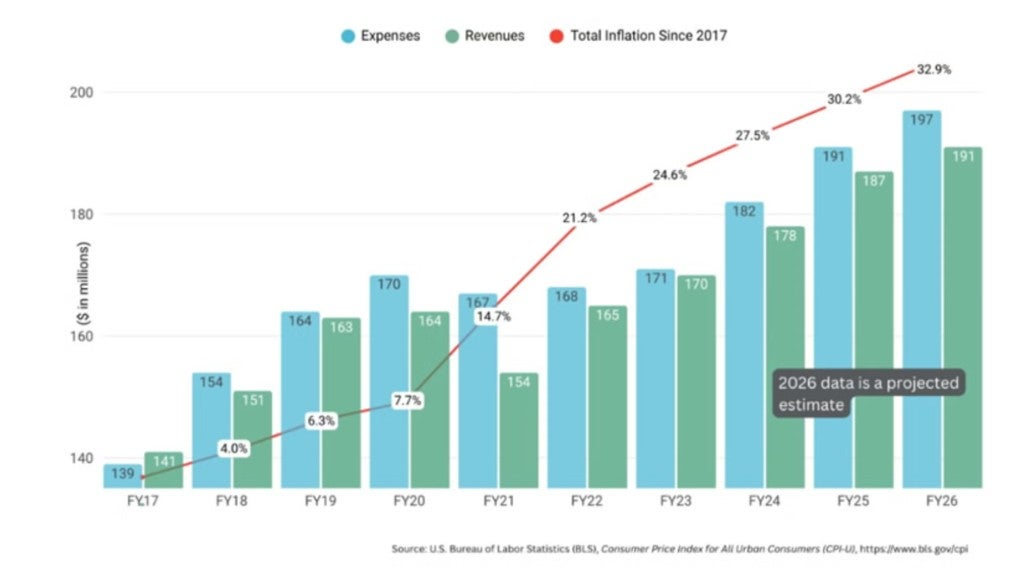
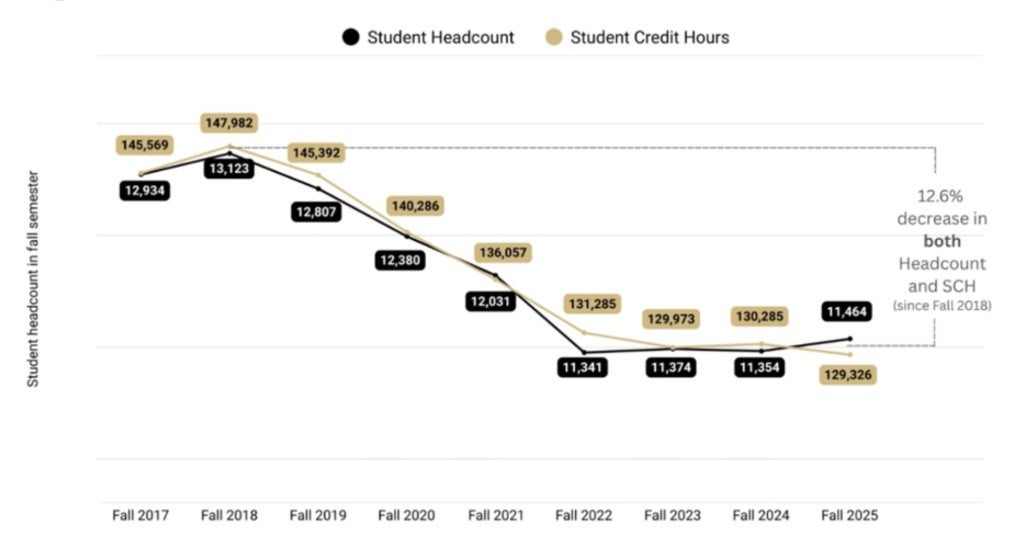
Our campus is in a place of challenge. We have real and ongoing budget issues that require our immediate attention and sustained work. The signs of financial distress outlined by the National Association of College and University Budget Officers (NACUBO) mirror issues on our own campus.
- Declining or unstable enrollment relative to expense base
- Repeated use of reserves to cover structural deficits
- Deferred maintenance or capital reinvestment delays that hurt the institution’s ability to deliver a quality experience for students and a supportive environment for academics
- Diminishing auxiliary margins that keep the institution locked in the status quo or worse
- Unclear financial practices at college and division level creating an unclear financial picture
Specifically, our campus has experienced eight consecutive years of budget reductions and reallocations. Even with that work, we continue to experience revenue growth at only 2.62 percent which outpaces our expense growth at 3.34 percent.
We aren’t alone. Many institutions of higher education have experienced the same issues related to shrinking state support, growing competition, declining student enrollment, expanding expectations for enhanced student experiences and growing regulatory expenses.